
 Raise The Rouf Health
 Introduction
I want you to take a minute to reflect… On any given day, how often do you…
- Base your daily choices on what other’s may think of you?
- Want someone you love to change something about how they’re living?
- Compared yourselves or feel jealous of the other’s successes?
- Waste energy and time over things we simply have NO control over?
Maybe you want your loved one to make healthier choices. Or you’re angry because someone got this brand new house you can’t help but feel jealous of. Avoiding going to the gym because of what other’s may think or say to us.
For most of us, it’s pretty eye opening to realize just how much of our life is spent in the depths of the uncontrollable.
Scenarios, like the ones above, take up a huge chunk of our lives. We spend so much time focusing on things we simply cannot control and giving our power to other people, that we don’t have enough to put towards bettering ourselves!
In Mel Robbin’s book, “The Let Them Theory,” she dives into how the use of a simple phrase can change our lives, shifting our focus from aspects of life we can’t control to ones that we can. In doing so, this allows us to strive towards the best person we can become!
What Is the “Let Them Theory”?
Popularized by author, Mel Robbins, this theory, at it’s core, consists of two phrases, “Let Them” and “Let Me.”
When you come across something in life that you cannot control, saying “Let Them” pushes you to “release” your desire and attempt to try to control something that you really never could in the first place.
Whenever you say “Let Them,” you must follow it up by saying “Let Me.” This gives you the chance to recognize and act on what you can control.
In combination, you are taking some scenario, releasing your hold on the uncontrollable, and then redirecting that same energy to something that you can control!
Here’s an example!
Say that your out in public, and someone is being very obnoxious and inconsiderate, something I think we all have experienced on many occasions. The default here is to say things like, “Wow, why are they doing that? That’s so annoying. I wish they would stop.”
- Applying the theory, you would simply say, “Let Them. Let them be obnoxious and rude. I cannot control how they act, so I shouldn’t waste me time and energy on trying to change it.”
- Next, you would say “Let me. Let me practice my patience. Let me politely approach them and express my concern. Let me put myself in this person’s shoes. Let me.”
I now challenge you to come up with a few common examples in your everyday life! Feel free to share them in the comments of this post!
Stephen Covey’s Two Circles Model
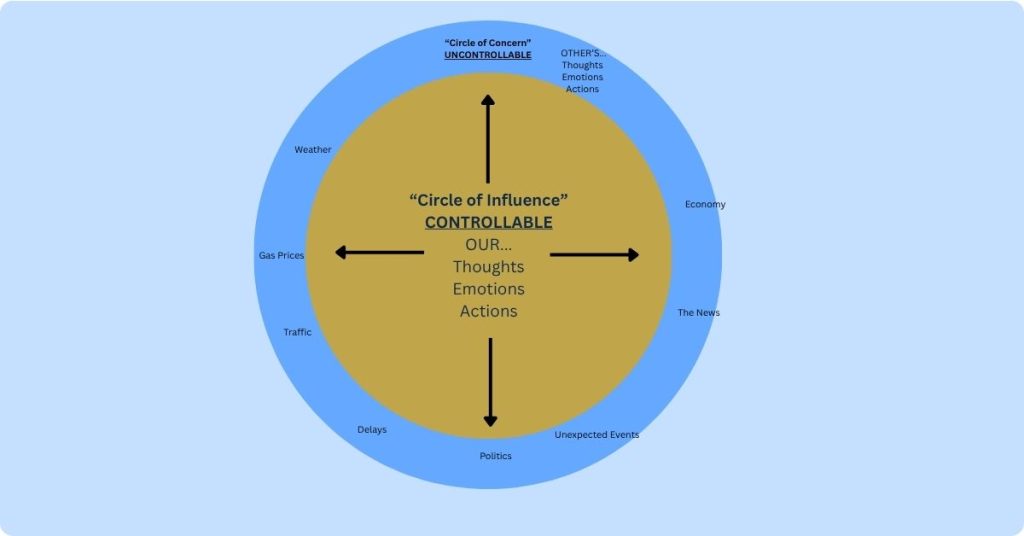
A very similar model that connects very well to the “Let Them” Theory comes from Stephen Covey and his book, “The Seven Habits of Highly Effective People. Covey uses the analogy of two circles, a smaller one inside a larger one
- Circle of Concern (Outer Circle): everything you care about or that affects you — the news, other people’s behavior, the economy, traffic, etc.
- Circle of Influence (Smaller Inner Circle): the things you can actually act on or change. Your thoughts, emotions, and actions
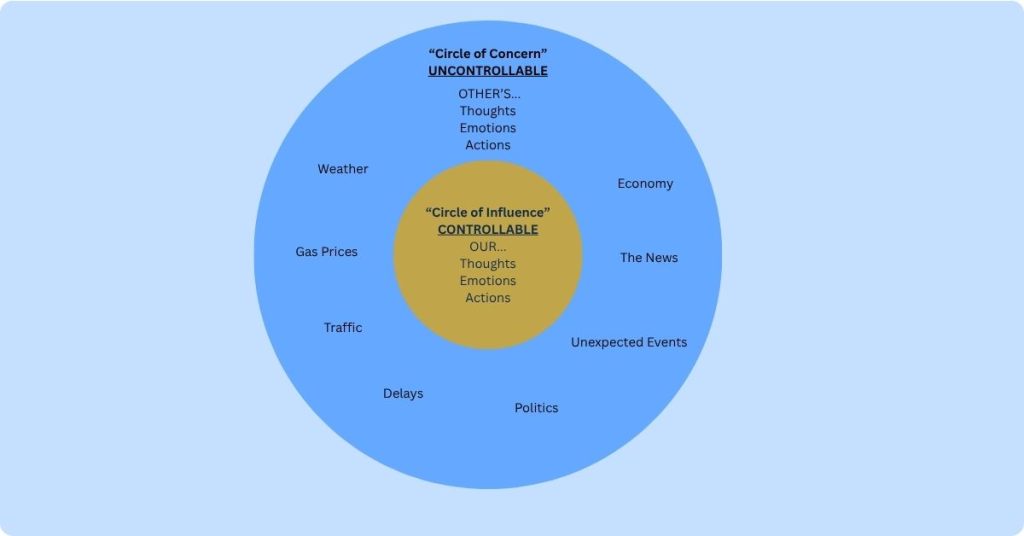
The more time we spend reacting to things and focusing on what we can’t control, the larger that outer circle grows, shrinking our inner circle as a result.
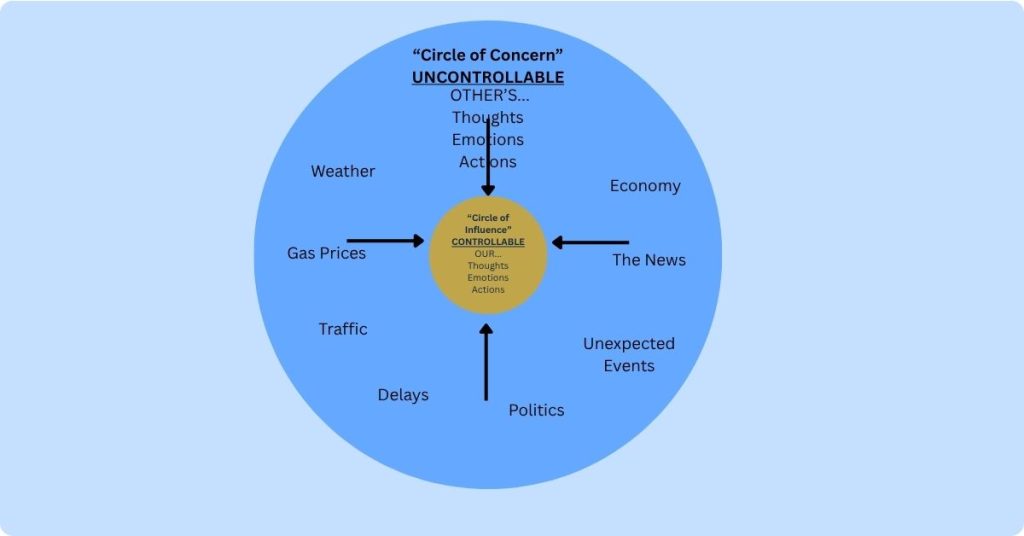
Fortunately, the opposite is true as well. When we spend more of our time and energy being proactive and focusing on what we can control, that inner circle grows, leaving us with a smaller outer circle and thus less opportunity, time, and care towards worrying about things we can’t control!
Wrapping Up
To become the best version of ourselves, to constantly be taking steps forward, we want as much of our time and energy directed towards growing ourselves as possible. When we spend all this time worrying about and giving power to other people, we are taking away from growth we could be achieving!
It’s human nature to feel this way, to want control, even in situations we’re we simply can’t do anything, period. Realizing and releasing our grip on the uncontrollable is not easy, but like with anything, it’s not about being perfect. It’s about taking consistent steps forward, no matter how small!
I encourage you to experiment with this concept in your everyday life. Start picking out any given scenario, identify what’s our of your control (“Let Them”) and what is in your control (“Let Me”). Once you start to bring your focus to the controllable things in life, you’ll find yourself a much happier and healthier you! The control is in your hands, and only you can decide what you direct your time and energy towards. Choose the controllable!
Thank you for reading! If your interested in learning more about this concept, check out “The Let Them Theory” by Mel Robbins, on my shop page by clicking the image below! I am currently over half-way through and am loving it so far. I really do think it contains a lot of useful and applicable ideas that we all could benefit from hearing! Give it a read!